
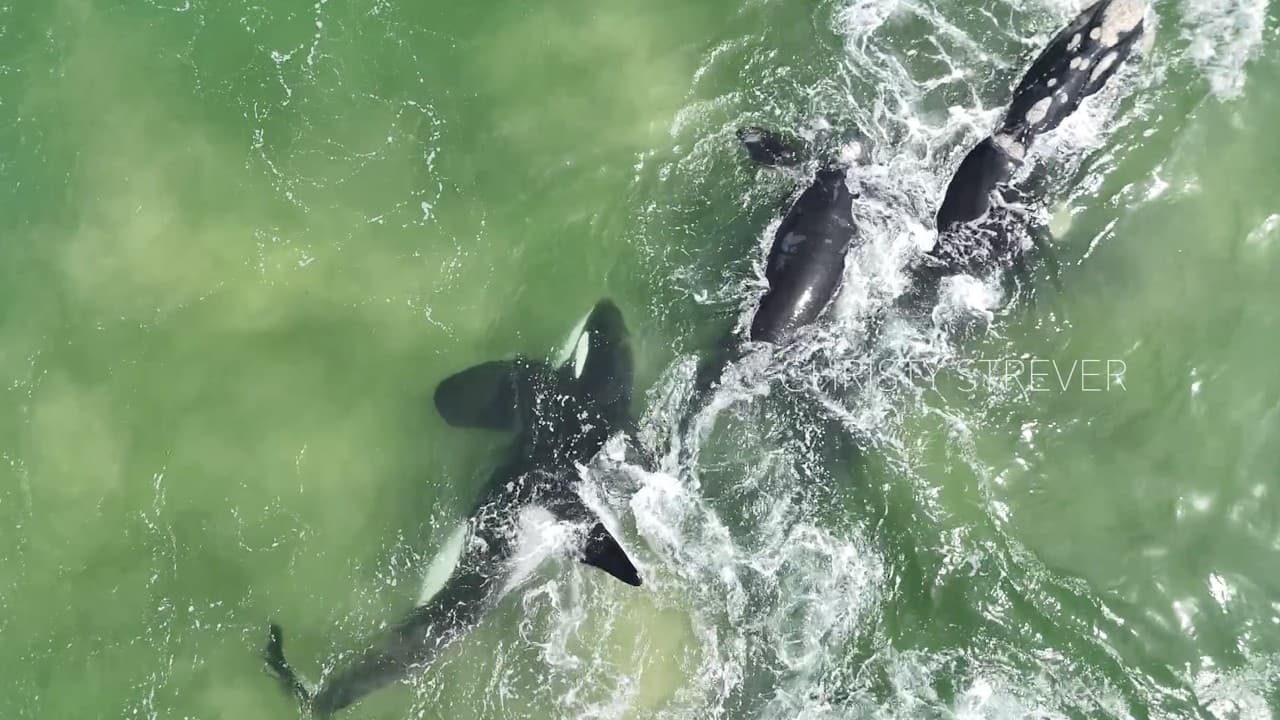
On 14 October 2026, Christy Strever posted a film from her hometown, Plettenberg Bay. It runs 3 minutes 51 seconds. In the film, and in the caption she wrote for it, two orcas spend about four hours trying to reach a southern right calf a few hundred metres offshore. The mother keeps the calf against her side in the shallows. The orcas leave. The mother and calf are still together. Plett Tourism published that account the next day and credited the film to her.
The narration is specific about the shape of the encounter and silent about the names. The orcas come in from the sides and stay clear of the mother's tail. The calf moves across her head. They circle, pass between the whales and a nearby boat, and take turns in the shallows. Strever calls them occasional visitors to these waters. The boat is not named. Nothing in the clip says the calf was examined afterwards.
Other people filmed orcas and a calf in the same days
Three Instagram reels describe a similar attempt. Their captions do not put everyone on the same boat, or even in the same bay.
Gustav Schlechter, who films from Plettenberg Bay, wrote that he filmed his first pair of orcas in Plett the day after they had spent more than four and a half hours trying to separate a southern right calf from its mother. On his telling, his reel is the orcas after the attempt, not the four hours themselves.
Bryce Milford wrote that he sat for four hours while orcas hunted a whale calf, and that the mother kept the baby. He did not name a beach. He also wrote that the only recorded predation of a southern right calf by two orcas had happened two weeks earlier.
Marnus de Klerk posted a reel tagged Jongensfontein, the bay just west of Stilbaai. He wrote that two orcas tried to separate a southern right calf and failed, and that they could be the same two recently seen in Plettenberg Bay. He does not say the clip was shot in Plett. Until someone matches the animals or the day, Jongensfontein stays a possible second encounter.
What the films do not establish
Nobody in these accounts names the orcas. Port and Starboard, the pair known for bent dorsal fins and for killing great white sharks off the Western Cape, are not identified here.
A search summary circulating this week credits Ocean Safaris with documenting the hunt on 15 October, and describes a narrator explaining that changing wave patterns let orcas find mother-and-calf pairs. That does not match Strever's film, the three captions, or Ocean Safaris' own pages. Ocean Safaris is a permitted whale-watching boat at Central Beach in Plett. It is a real operator. It is not named in the footage checked for this story. The date 15 October is the day Plett Tourism published Strever's account.
The calendar day of the attempt is still open. Strever posted on 14 October. Schlechter's "yesterday" needs the date of his own post, which the public caption does not carry. A search of the Knysna-Plett Herald on 19 October did not turn up a report of this encounter.
The season around it
Southern right whales use the South African coast to calve. On 7 October, the Mammal Research Institute Whale Unit finished its 2026 aerial survey. Hermanus Times reported 222 cow-calf pairs and 25 unaccompanied adults, about 100 more calves than in 2025. Prof Els Vermeulen said the population is still growing, at about 6.5% a year, slower than the earlier estimate of about 7%. Most of those pairs were at De Hoop, Struisbaai and Walker Bay, the three nursery areas the unit has counted for decades. The survey does not place this Plett calf on a map.
Orcas are the unusual part. Plett Tourism has described them as infrequent in the bay. In March 2023, after a separate visit by a larger group, Nelson Mandela University scientist Gwen Penry told the Knysna-Plett Herald that a sighting was exciting because the animals are rare along this coast, and that the orcas seen off South Africa are the transient kind, travelling long distances. That was a different visit. It is the closest local scientific comment on how uncommon orcas are here.
What the filmmakers agree on is the outcome they saw. The mother stayed. The orcas left. The calf was still with her.